
Integrating Sensors with Fertigation for Precision Nutrition Management in High-Value vegetable Crops.
Updated: Jul 9

Abstract
High-value vegetable production requires precise management of water and nutrients to maximize productivity while minimizing environmental impacts. Conventional irrigation and fertilization practices often result in inefficient resource utilization due to nutrient losses, water wastage, and uneven nutrient distribution. Precision agriculture has emerged as a transformative approach that integrates modern technologies such as sensors, the Internet
of Things (IoT), automation, and data analytics to optimize crop management. Among these technologies, sensor-integrated fertigation systems provide real-time monitoring of soil, crop, and environmental conditions, enabling site-specific application of water and nutrients according to crop requirements. Sensors such as soil moisture probes, electrical conductivity (EC) sensors, pH sensors, weather stations, and plant health sensors continuously collect field data, allowing automated controllers to regulate irrigation scheduling and fertilizer injection. This technology improves nutrient use efficiency, increases crop yield and quality, conserves water resources, reduces fertilizer costs, and minimizes environmental pollution caused by nutrient leaching and greenhouse gas emissions. Furthermore, advances in wireless sensor networks, cloud computing, artificial intelligence (AI), and machine learning have enhanced the decision-making capabilities of precision fertigation systems, making them more accurate and reliable. Despite challenges such as high installation costs, technical complexity, and maintenance requirements, sensor-based fertigation offers considerable opportunities for sustainable vegetable production under changing climatic conditions. This review examines the principles, sensor technologies, applications, benefits, challenges, and future prospects of integrating sensors with fertigation for precision nutrition management in high-value vegetable crops.
Keywords: Precision agriculture; Fertigation; Sensor technology; Precision nutrition; High-value vegetables; Internet of Things (IoT); Automation; Smart irrigation.
Contents
1. Introduction
Agriculture is currently undergoing a technological transformation driven by the need to increase food production while reducing environmental impacts and improving resource use efficiency. Rapid population growth, climate change, water scarcity, and declining soil fertility have intensified the demand for innovative farming practices capable of producing more food using fewer resources (Food and Agriculture Organization (Organization., 2022).High-value vegetable crops, including tomato (Solanum lycopersicum), sweet pepper (Capsicum annuum), cucumber (Cucumis sativus), lettuce (Lactuca sativa), onion (Allium cepa), and eggplant (Solanum melongena), require precise management of irrigation and nutrient supply because they possess shallow root systems, high nutrient demand, and short production cycles (Shamshiri, R. R., Kalantari, F., Ting, K. C., et al. , 2018).
Traditional fertilizer application methods typically involve broadcasting or side dressing fertilizers at predetermined intervals without considering real-time crop nutrient demand or soil moisture conditions. These practices often lead to excessive fertilizer application, nutrient leaching, groundwater contamination, and increased production costs (Zotarelli, L., Dukes, M. D., Scholberg, J. M., Muñoz-Carpena, R., & Icerman, J, 2020). Likewise, conventional irrigation scheduling based solely on farmer experience or fixed calendars frequently results in under-irrigation or over-irrigation, adversely affecting crop growth and water use efficiency (Jones, H. G. , 2014)
Fertigation, defined as the application of fertilizers through irrigation systems, has become one of the most efficient methods of supplying nutrients directly to the plant root zone. Drip fertigation significantly improves nutrient distribution, reduces fertilizer losses, and allows flexible adjustment of nutrient concentrations throughout different crop growth stages (Burt, C. M., O'Connor, K., & Ruehr, T, 1998). Nevertheless, conventional fertigation systems still depend largely on predetermined irrigation schedules rather than real-time crop conditions.
The emergence of precision agriculture has revolutionized fertigation management by integrating sensors, automated controllers, communication technologies, and decision-support systems. Precision agriculture refers to the use of advanced technologies to observe, measure, and respond to spatial and temporal variability within agricultural fields, thereby optimizing crop production while minimizing environmental impacts (Gebbers & Adamchuk, 2010). Sensor-based fertigation systems continuously monitor soil moisture, electrical conductivity, pH, climatic conditions, and crop physiological responses to determine optimal irrigation timing and nutrient application rates.
Recent developments in wireless sensor networks, Internet of Things (IoT) platforms, cloud computing, and artificial intelligence have further enhanced the capability of precision fertigation systems. These technologies enable farmers to remotely monitor field conditions, receive automated alerts, predict crop water requirements, and adjust fertilizer applications using smartphone applications or web-based platforms (Liakos, K. G., Busato, P., Moshou, D., Pearson, S., & Bochtis, D. , 2018). Such systems support data-driven decision-making and improve resource use efficiency in both greenhouse and open-field vegetable production.
Sensor technologies play a central role in precision nutrition management. Soil moisture sensors determine the amount of available water within the root zone, ensuring that irrigation occurs only when necessary. Electrical conductivity sensors estimate nutrient concentration within the soil solution or fertigation water, while pH sensors help maintain optimal nutrient availability. Weather stations provide information on temperature, humidity, solar radiation, wind speed, and rainfall, allowing estimation of crop evapotranspiration and irrigation demand. Plant-based sensors, including chlorophyll meters, canopy reflectance sensors, and multispectral imaging systems, assess crop health and nutrient status directly from plant responses (Jones, H. G., 2004)
The adoption of sensor-integrated fertigation offers numerous agronomic, economic, and environmental benefits. Improved synchronization between crop nutrient demand and fertilizer supply enhances nutrient use efficiency, increases vegetable yield, improves product quality, and reduces production costs. Moreover, precise nutrient application minimizes nitrogen and phosphorus losses, thereby reducing groundwater contamination, eutrophication, and greenhouse gas emissions associated with excessive fertilizer use (Organization., 2022).
Despite these advantages, widespread adoption of sensor-based fertigation remains constrained by several factors, including high installation costs, limited technical expertise among farmers, sensor calibration requirements, unreliable internet connectivity in rural areas, and maintenance challenges. Continued research and technological innovation are therefore essential to improve affordability, reliability, and user-friendliness of precision fertigation systems.
This review aims to examine current developments in integrating sensors with fertigation systems for precision nutrition management in high-value vegetable crops. Specifically, it discusses the principles of precision fertigation, major sensor technologies, automation systems, crop-specific applications, benefits, challenges, and future research directions for sustainable vegetable production.
2. Literature Review
2.1 Overview of Precision Agriculture
Precision agriculture (PA) is an innovative farm management approach that uses advanced technologies to observe, measure, and respond to variability in crop production systems. Unlike conventional farming, where management practices are applied uniformly across an entire field, precision agriculture recognizes that soil properties, crop growth, water availability, and nutrient status vary spatially and temporally. By using sensors, global positioning systems (GPS), geographic information systems (GIS), remote sensing, and variable-rate technologies, farmers can make data-driven decisions that optimize crop productivity while minimizing environmental impacts (Gebbers & Adamchuk, 2010).
The increasing demand for food production, combined with limited natural resources and climate variability, has accelerated the adoption of precision agriculture worldwide. The Food and Agriculture Organization (Organization., 2022).emphasizes that digital agriculture is essential for achieving sustainable intensification by increasing productivity while conserving soil, water, and biodiversity. Precision agriculture has become particularly important in high-value vegetable production because these crops require intensive management and have high economic returns.
Modern precision agriculture integrates the Internet of Things (IoT), cloud computing, artificial intelligence (AI), machine learning, and wireless communication systems. These technologies allow continuous monitoring of field conditions and facilitate automated management of irrigation, fertilization, pest control, and environmental conditions. As a result, farmers can improve operational efficiency, reduce labor requirements, and enhance profitability (Liakos, K. G., Busato, P., Moshou, D., Pearson, S., & Bochtis, D. , 2018)
2.2 Evolution of Fertigation Technology
Fertigation refers to the application of dissolved fertilizers through irrigation systems, particularly drip and sprinkler irrigation. Since its introduction in the 1970s, fertigation has become one of the most efficient nutrient delivery methods because nutrients are supplied directly to the plant root zone in soluble form (Burt, C. M., O'Connor, K., & Ruehr, T, 1998)
Initially, fertigation systems operated manually, requiring farmers to prepare fertilizer solutions and inject them into irrigation systems according to fixed schedules. Although these systems improved nutrient use efficiency compared with traditional fertilizer broadcasting, they lacked flexibility because nutrient application was not adjusted according to changing crop requirements or environmental conditions.
Recent technological developments have transformed fertigation into an automated precision management system. Modern fertigation systems employ programmable logic controllers (PLCs), electronic solenoid valves, fertilizer injectors, and sensor networks that continuously monitor soil moisture, nutrient concentration, irrigation pressure, and environmental conditions. These systems automatically regulate irrigation duration and fertilizer injection rates according to real-time field conditions (Raviv & Lieth, 2008).
Automation has significantly improved nutrient use efficiency by ensuring that crops receive the right amount of nutrients at the appropriate growth stage while minimizing fertilizer losses through leaching or runoff.
2.3 Precision Nutrition in Vegetable Production
Precision nutrition involves supplying nutrients according to the specific physiological needs of crops at different growth stages. High-value vegetables require balanced nutrient availability because deficiencies or excesses can significantly reduce yield and market quality.
For example, tomato plants require high nitrogen during vegetative growth, increased phosphorus during flowering, and high potassium during fruit development. Calcium is essential for preventing blossom-end rot, while magnesium supports chlorophyll formation and photosynthesis (Zotarelli, L., Dukes, M. D., Scholberg, J. M., Muñoz-Carpena, R., & Icerman, J, 2020)
Traditional fertilizer recommendations often fail to account for variability in soil fertility, weather conditions, or crop nutrient uptake. Precision nutrition addresses this limitation by combining sensor data with crop nutrient models to determine fertilizer requirements in real time. Soil electrical conductivity (EC), pH, moisture status, and plant nutrient indices provide valuable information for adjusting fertilizer applications throughout the growing season.
This approach improves fertilizer use efficiency while reducing production costs and environmental pollution.
2.4 Sensor Technologies in Precision Agriculture
Sensors are the foundation of precision fertigation systems because they provide continuous measurements of soil, crop, and environmental conditions.
2.4.1 Soil Moisture Sensors
Soil moisture sensors estimate the amount of water available within the crop root zone. Common technologies include:
Capacitive sensors
Frequency Domain Reflectometry (FDR)
Time Domain Reflectometry (TDR)
Tensiometers
These sensors determine irrigation timing and duration, thereby preventing both drought stress and excessive irrigation.
2.4.2 Electrical Conductivity (EC) Sensors
Electrical conductivity sensors measure dissolved salts within irrigation water or soil solution. Since fertilizer nutrients are dissolved salts, EC serves as an indirect indicator of nutrient concentration.
Maintaining optimum EC improves nutrient uptake while preventing salt accumulation that may reduce crop growth.
2.4.3 Soil pH Sensors
Soil pH strongly influences nutrient availability. Most vegetables perform best at a soil pH between 6.0 and 6.8, where essential nutrients remain readily available.
Continuous pH monitoring enables automatic correction through acid or alkaline fertilizer solutions.
2.4.4 Weather Sensors
Weather stations monitor:
Air temperature
Relative humidity
Solar radiation
Wind speed
Rainfall
These data are used to estimate crop evapotranspiration (ET), allowing irrigation scheduling based on actual crop water demand rather than fixed irrigation intervals.
Plant-Based Sensors
Plant sensors directly monitor crop health using indicators such as:
Chlorophyll content
Leaf temperature
Canopy reflectance
NDVI (Normalized Difference Vegetation Index)
Multispectral imaging
These technologies detect nutrient deficiencies before visual symptoms appear, allowing timely corrective actions.
2.5 Internet of Things (IoT) in Precision Fertigation
Internet of Things (IoT) refers to interconnected electronic devices capable of collecting, transmitting The, and processing data over communication networks.
In precision fertigation systems, IoT enables:
Continuous sensor monitoring
Wireless communication
Cloud-based data storage
Remote irrigation control
Smartphone monitoring
Automatic alarm generation
Decision support systems
Farmers can remotely start irrigation, adjust fertilizer concentrations, and receive notifications regarding abnormal soil moisture, nutrient levels, or equipment failures.
IoT significantly improves management efficiency, particularly in greenhouse vegetable production where environmental conditions change rapidly (Liakos, K. G., Busato, P., Moshou, D., Pearson, S., & Bochtis, D. , 2018)
2.6 Global Adoption of Sensor-Based Fertigation
Several countries have successfully implemented sensor-integrated fertigation systems.
Israel pioneered drip irrigation and precision fertigation technologies, achieving high water use efficiency in arid regions.
The Netherlands utilizes greenhouse automation with advanced climate control and fertigation systems for tomato, cucumber, and sweet pepper production.
Spain has adopted sensor-based fertigation in protected horticulture, improving nutrient management while reducing groundwater contamination.
Australia and the United States use wireless sensor networks and remote sensing technologies to optimize irrigation scheduling and fertilizer application.
In Africa, adoption remains limited due to high equipment costs, insufficient technical knowledge, and limited access to reliable internet infrastructure. Nevertheless, research institutions and development organizations continue to promote affordable sensor technologies suitable for smallholder vegetable farmers.
Table 2.1 Comparison of Conventional and Precision Fertigation Systems
Parameter | Conventional Fertigation | Sensor-Based Precision Fertigation |
Irrigation scheduling | Fixed schedule | Real-time monitoring |
Fertilizer application | Uniform rate | Variable rate based on crop demand |
Soil moisture monitoring | Manual | Automatic sensors |
Nutrient monitoring | Laboratory testing | Continuous EC and pH monitoring |
Labor requirement | High | Low |
Water use efficiency | Moderate | High |
Fertilizer use efficiency | Moderate | High |
Yield | Variable | Higher and more uniform |
Environmental pollution | Higher | Lower |
Decision making | Experience-based | Data-driven |
3. Sensor Technologies for Precision Fertigation
3.1 Introduction
The success of precision fertigation depends largely on the ability to accurately monitor soil, crop, water, and environmental conditions in real time. Sensors are the core components of modern precision agriculture because they provide continuous data that enable informed decisions regarding irrigation scheduling and fertilizer application. Unlike conventional farming, which relies on periodic field observations and laboratory analyses, sensor-based systems continuously monitor crop production conditions and automatically adjust irrigation and fertigation according to crop requirements (Jones, H. G., 2004)
Sensor technologies have become increasingly important in high-value vegetable production because these crops are highly sensitive to variations in soil moisture, nutrient availability, temperature, and salinity. Real-time monitoring allows growers to maintain optimal growing conditions throughout the crop cycle, thereby improving productivity, quality, and resource use efficiency (Shamshiri, R. R., Kalantari, F., Ting, K. C., et al. , 2018)
3.2 Classification of Sensors Used in Precision Fertigation
Sensors used in precision fertigation are generally classified into five major categories:
1) Soil sensors
2) Water quality sensors
3) Weather sensors
4) Plant sensors
5) Remote sensing technologies
Each category contributes unique information required for effective irrigation and nutrient management.
3.2.1 Soil Moisture Sensors
Principle of Operation
Soil moisture sensors determine the amount of water available within the crop root zone. These sensors operate by measuring changes in dielectric properties, electrical resistance, or soil water tension.
The measured moisture values are transmitted to irrigation controllers, which determine whether irrigation is required.
Common Types
a) Capacitive Sensors
Capacitive sensors estimate soil moisture by measuring changes in soil dielectric constant.
Advantages
Low cost
Easy installation
Fast response
Suitable for greenhouse production
Limitations
Sensitive to soil texture
Requires periodic calibration
Time Domain Reflectometry (TDR)
TDR sensors determine soil water content by measuring the travel time of electromagnetic waves through the soil.
Advantages
High accuracy
Long service life
Minimal maintenance
Disadvantages
Expensive
Requires specialized equipment
Frequency Domain Reflectometry (FDR)
FDR sensors measure changes in electromagnetic frequency caused by variations in soil water content.
Applications include:
Vegetable production
Orchard irrigation
Greenhouse cultivation
Tensiometers
Tensiometers measure soil water tension rather than water content.
They are particularly useful for:
Sandy soils
Drip irrigation
Vegetable production
Table 3.1 Comparison of Soil Moisture Sensors
Sensor Type | Accuracy | Cost | Maintenance | Suitable Application |
Capacitive | Moderate | Low | Low | Greenhouses |
TDR | Very High | High | Low | Research and commercial farms |
FDR | High | Medium | Moderate | Field vegetables |
Tensiometer | Moderate | Low | Moderate | Drip irrigation systems |
3.4 Electrical Conductivity (EC) Sensors
Electrical conductivity (EC) sensors measure the concentration of dissolved salts in irrigation water or soil solution.
Since fertilizers contain dissolved ions such as nitrate (NO₃⁻), potassium (K⁺), calcium (Ca²⁺), and magnesium (Mg²⁺), EC provides an indirect estimate of nutrient concentration.
Importance of EC Monitoring
Continuous EC monitoring helps farmers to:
High accuracy
Long service life
Minimal maintenance
Disadvantages
Expensive
Requires specialized equipment
Frequency Domain Reflectometry (FDR)
FDR sensors measure changes in electromagnetic frequency caused by variations in soil water content.
Applications include:
Vegetable production
Orchard irrigation
Greenhouse cultivation
Tensiometers
Tensiometers measure soil water tension rather than water content.
They are particularly useful for:
Sandy soils
Drip irrigation
Vegetable production
Table 3.1 Comparison of Soil Moisture Sensors
Sensor Type | Accuracy | Cost | Maintenance | Suitable Application |
Capacitive | Moderate | Low | Low | Greenhouses |
TDR | Very High | High | Low | Research and commercial farms |
FDR | High | Medium | Moderate | Field vegetables |
Tensiometer | Moderate | Low | Moderate | Drip irrigation systems |
3.4 Electrical Conductivity (EC) Sensors
Electrical conductivity (EC) sensors measure the concentration of dissolved salts in irrigation water or soil solution.
Since fertilizers contain dissolved ions such as nitrate (NO₃⁻), potassium (K⁺), calcium (Ca²⁺), and magnesium (Mg²⁺), EC provides an indirect estimate of nutrient concentration.
Importance of EC Monitoring
Continuous EC monitoring helps farmers to:
Chlorophyll Meters
These estimate leaf chlorophyll content, which correlates closely with nitrogen status.
Benefits include:
Ø Early detection of nitrogen deficiency
Ø Reduced unnecessary fertilizer application
Ø Improved crop quality
Ø Infrared Thermometers
Ø Infrared sensors measure canopy temperature.
Ø When plants experience water stress:
Ø Stomata close
Ø Leaf temperature rises
Irrigation is automatically triggered
NDVI Sensors
The Normalized Difference Vegetation Index (NDVI) assesses crop vigor using reflected red and near-infrared light.
Applications include:
Nutrient deficiency detection
Biomass estimation
Growth monitoring
Yield prediction
3.8 Remote Sensing Technologies
Remote sensing complements ground-based sensors through:
Satellite imagery
Drone imaging
Multispectral cameras
Hyperspectral cameras
Thermal imaging
These technologies enable monitoring of large production areas and early detection of crop stress.
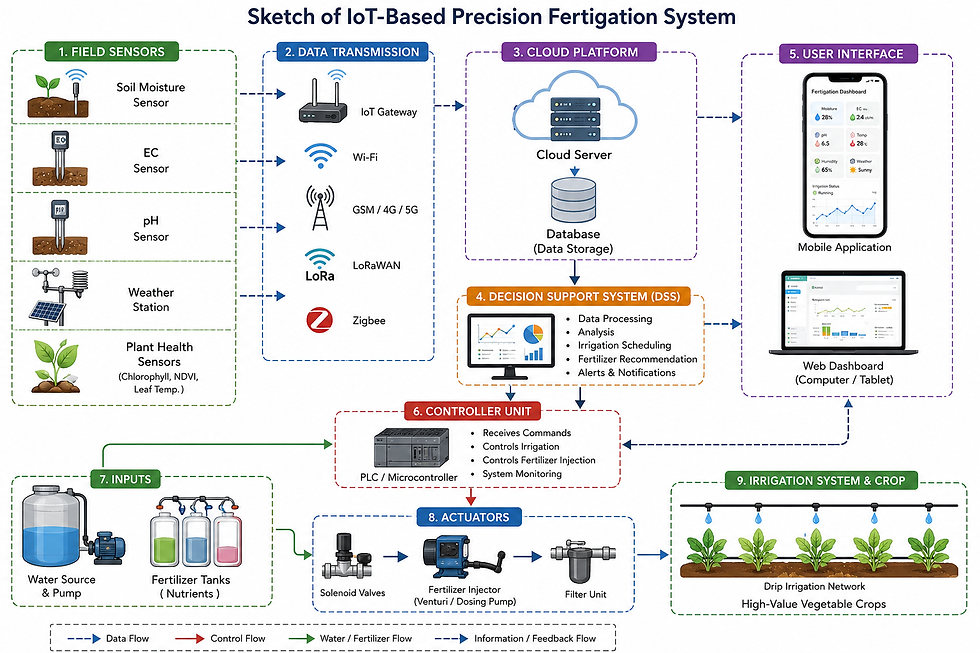
3.9 Internet of Things (IoT) Integration
Modern precision fertigation systems connect all sensors through IoT networks.
3.10 Sensor Calibration and Maintenance
Proper calibration is essential to ensure accurate measurements. Recommended practices include:
Calibrate moisture sensors before each cropping season.
Clean EC and pH probes regularly to remove deposits.
Replace damaged cables and connectors.
Verify weather station readings against standard instruments.
Protect sensors from physical damage during field operations.
Maintain battery power or solar charging systems.
Routine maintenance increases sensor lifespan and improves decision accuracy.
3.11 Advantages of Sensor Technologies
The integration of sensors into fertigation systems provides several benefits:
Continuous real-time monitoring.
Improved irrigation scheduling.
Enhanced fertilizer management.
Higher nutrient use efficiency.
Increased crop yield and quality.
Reduced labor costs.
Water conservation.
Reduced environmental pollution.
Remote monitoring through smartphones and computers.
Data collection for long-term farm management.
3.12 Challenges
Despite their advantages, sensor technologies face several constraints:
High initial investment costs.
Sensor calibration requirements.
Technical skills needed for operation.
Internet connectivity limitations in rural areas.
Equipment maintenance costs.
Limited access to technical support.
Future innovations are expected to reduce these barriers through affordable wireless sensors and AI-driven decision-support systems.
4. Automation, Internet of Things (IoT), and Artificial Intelligence in Precision Fertigation
4.1 Introduction
Automation, the Internet of Things (IoT), and Artificial Intelligence (AI) have transformed modern agriculture by enabling continuous monitoring, real-time decision-making, and precise control of irrigation and nutrient management. In high-value vegetable production, automated fertigation systems integrate sensors, controllers, communication networks, and decision-support software to optimize water and fertilizer application based on crop requirements rather than fixed schedules (Liakos, K. G., Busato, P., Moshou, D., Pearson, S., & Bochtis, D. , 2018)
Conventional irrigation systems often depend on manual operation and farmer experience, which can lead to inefficient water use and nutrient losses. Automated precision fertigation addresses these limitations by collecting real-time data from soil, plant, and environmental sensors and using programmable controllers to regulate irrigation valves and fertilizer injectors. This technology improves crop productivity, conserves resources, and reduces labor requirements.
4.2 Automation in Precision Fertigation
Automation refers to the use of electronic and mechanical systems that perform irrigation and fertilizer application with minimal human intervention. A typical automated fertigation system consists of:
Soil moisture, EC, and pH sensors
Weather station
Water source and pumping unit
Fertilizer storage tanks
Fertilizer injectors (Venturi injectors or dosing pumps)
Solenoid valves
Programmable Logic Controller (PLC) or microcontroller
Wireless communication devices
Cloud server
Farmer interface (mobile application or web dashboard)
The controller receives information from sensors, processes the data using pre-programmed algorithms, and activates irrigation and fertilizer injection when predefined thresholds are reached.
Advantages of Automation
Precise timing of irrigation and fertigation
Reduced labor costs
Improved water and fertilizer use efficiency
Continuous system monitoring
Reduced human error
Increased crop uniformity
Remote system operation
4.3 Internet of Things (IoT) in Precision Agriculture
The Internet of Things (IoT) is a network of interconnected devices that communicate through the internet to exchange data. In agriculture, IoT enables sensors, controllers, pumps, and mobile devices to work together as an integrated system.
Key Components of an IoT-Based Fertigation System
Sensors: Collect data on soil moisture, EC, pH, temperature, humidity, and crop conditions.
Communication Network: Transmits data using Wi-Fi, GSM, LoRaWAN, Zigbee, Bluetooth, or NB-IoT.
Cloud Platform: Stores and processes collected data.
Decision-Support System: Analyzes data and recommends or automatically applies irrigation and fertilizer schedules.
User Interface: Allows farmers to monitor and control the system remotely through smartphones or computers.
IoT enables continuous field monitoring and immediate responses to changing environmental conditions.
4.4 Communication Technologies
Reliable communication is essential for transmitting sensor data. Common technologies include:
Technology | Range | Power Consumption | Agricultural Application |
Wi-Fi | Short | High | Greenhouses |
Bluetooth | Very Short | Low | Small farms |
Zigbee | Medium | Low | Sensor networks |
LoRaWAN | Long | Very Low | Large farms |
GSM/4G/5G | Very Long | Moderate | Remote monitoring |
NB-IoT | Long | Very Low | Smart agriculture |
LoRaWAN and NB-IoT are increasingly preferred because they support long-distance communication while consuming little power.
4.5 Decision Support Systems (DSS)
A Decision Support System (DSS) is software that analyzes sensor data and recommends irrigation and fertigation strategies.
A DSS typically integrates:
Soil moisture measurements
Weather forecasts
Crop growth stage
Soil nutrient status
Historical irrigation records
Fertilizer application history
The DSS calculates:
Irrigation timing
Irrigation duration
Fertilizer concentration
Water requirements
Nutrient requirements Advanced systems automatically send commands to irrigation controllers, reducing the need for manual intervention.
4.6 Artificial Intelligence (AI) Applications
Artificial Intelligence enables automated systems to learn from historical and real-time data, improving management decisions over time.
Applications of AI
Predicting crop water requirements
Forecasting nutrient deficiencies
Detecting irrigation system failures
Optimizing fertilizer application rates
Predicting crop yield
Identifying plant diseases through image analysis
Improving greenhouse climate control
Machine learning algorithms can analyze large datasets to identify patterns that are difficult to detect manually, resulting in more efficient resource management.
Table 4.2. Applications of AI in Precision Fertigation
AI Application | Benefit |
Irrigation prediction | Saves water and energy |
Nutrient recommendation | Improves fertilizer use efficiency |
Disease detection | Early intervention |
Yield prediction | Better production planning |
Weather forecasting | Improved irrigation scheduling |
Equipment monitoring | Reduces maintenance costs |
4.7 Cloud Computing
Cloud computing allows agricultural data to be stored and processed on remote servers, making it accessible from any location.
Benefits include:
Secure data storage
Real-time monitoring
Data backup
Historical trend analysis
Remote software updates
Integration with weather forecasting services
Cloud platforms also facilitate collaboration among farmers, agronomists, and researchers.
4.8 Mobile Applications in Precision Fertigation
Smartphone applications provide a user-friendly interface for managing automated fertigation systems.
Typical features include:
Viewing real-time sensor readings
Starting or stopping irrigation
Adjusting fertilizer injection rates
Receiving alerts for abnormal conditions
Viewing historical data and reports
Monitoring water and fertilizer consumption
Examples include proprietary applications provided by irrigation equipment manufacturers and customized farm management software.
4.9 Benefits of Automation, IoT, and AI
The integration of automation, IoT, and AI into fertigation systems provides numerous advantages:
Increased irrigation efficiency
Reduced fertilizer losses
Improved nutrient uptake
Reduced labor requirements
Better crop health monitoring
Early detection of equipment failures
Enhanced decision-making
Improved crop yield and quality
Environmental protection through reduced nutrient leaching
Improved farm profitability
4.10 Challenges
Despite their benefits, several barriers limit adoption:
High initial investment costs
Limited internet connectivity in rural areas
Need for technical training
Cybersecurity concerns
Sensor calibration requirements
Maintenance of electronic equipment
Data management challenges
Addressing these issues requires affordable technologies, farmer training, and supportive agricultural policies.
4.11 Future Trends
Emerging technologies expected to enhance precision fertigation include:
Artificial Intelligence (AI)
Machine Learning (ML)
Digital Twins
Robotics
Autonomous irrigation systems
Drone-based nutrient monitoring
Satellite-assisted irrigation scheduling
Blockchain for agricultural data security
Edge computing for real-time decision-making
These innovations will improve system efficiency, reduce costs, and support climate-smart agriculture.
5. CONCLUSION
Integrating sensors with fertigation systems represents a significant advancement in precision nutrition management for high value vegetable crops. By continuously monitoring soil, plant, and environmental conditions, sensor based fertigation enables precise application of water and nutrients according to the crop demand. This technology enhances nutrients use efficiency, conserves water resources,improves crop yield and quality ,reduce production costs, minimizes environmental impacts.
Bibliography
Allen, R. G., Pereira, L. S., Raes, D., & Smith, M. (1998). Crop evapotranspiration: Guidelines for computing crop water requirements (FAO Irrigation and Drainage Paper No. 56). Food and Agriculture Organization.
Burt, C. M., O'Connor, K., & Ruehr, T. (1998). Fertigation. Irrigation Training and Research Center.
Jones, H. G. . (2014). Plants and microclimate: A quantitative approach to environmental plant physiology (3rd ed.). : Cambridge University Press.
Jones, H. G. ( 2004). Irrigation scheduling: Advantages and pitfalls of plant-based methods. Journal of Experimental Botany, 55(407), 2427–2436.
Liakos, K. G., Busato, P., Moshou, D., Pearson, S., & Bochtis, D. . (2018). Machine learning in agriculture: A review. Sensors, 18(8), 2674.
Organization., F. a. (2022). The State of Food and Agriculture 2022. FAO.
Shamshiri, R. R., Kalantari, F., Ting, K. C., et al. . (2018). Advances in greenhouse automation and controlled environment agriculture. Information Processing in Agriculture, 5(1), 1–30.
Zotarelli, L., Dukes, M. D., Scholberg, J. M., Muñoz-Carpena, R., & Icerman, J. ( 2020). Nitrogen and water management in vegetable production systems. HortScience, 55(5), 665–672.
Comments